
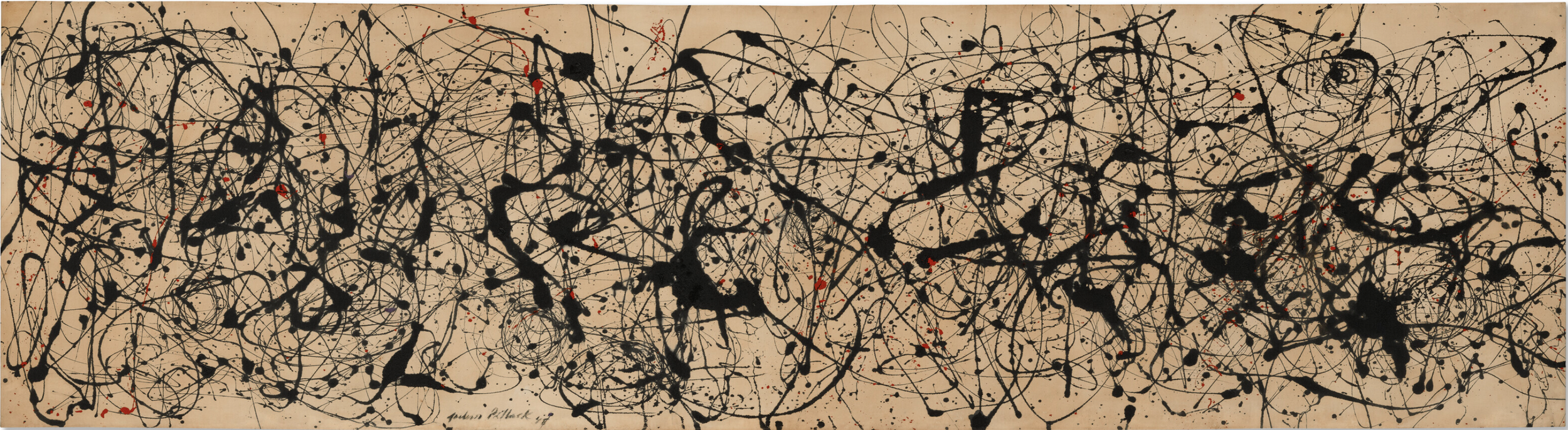
In the May 2026 auctions held over the past two weeks, 12 lots sold for over $40 million each (two more than in the Nov. 2025 sales) for a cumulative total of $851,022,500 (including buyer's premium). All of these $40M+ works were created in the twentieth century, and all were sold either at Christie's or Sotheby's with third-party guarantees (or "irrevocable bids" in Sotheby's terminology), so a strong high end was a foregone conclusion heading into the sales. Among this group, auction records were set for set for Jackson Pollock (who led the season), Constantin Brancusi, Mark Rothko, and Joan Miró.
In my calculations, 87.6% of the totals for $40M+ lots were from estate property, including the three highest lots, an even more pronounced pattern than what we saw in the November 2025 auctions (74%), further demonstrating that fluctuations in overall season-to-season results often depend more on circumstance-driven changes in supply at the high end than on changes in market confidence. However, to hedge against that comment a bit, there can be an element of discretion in when to sell estate property, as for Newhouse, in which works have been released to market periodically over time; clearly, they felt emboldened to sell key works now, and did so to remarkable results.
The top 12 in descending order of price realized:
1. Jackson Pollock, Number 7A (1948): $181,185,000 at Christie's (*auction record)
2. Constantin Brancusi, Danaïde (ca. 1913): $107,585,000 at Christie's (*auction record)
3. Mark Rothko, No. 15 (Two Greens and Red Stripe) (1964): $98,385,000 at Christie's (*auction record)
4. Mark Rothko, Brown and Blacks in Reds (1957): $85,780,000 at Sotheby's
5. Joan Miró, Portrait de Madame K. (1924): $53,535,000 at Christie's (*auction record)
6. Jean-Michel Basquiat, Museum Security (Broadway Meltdown) (1983): $52,717,500 at Sotheby's
7. Henri Matisse, La Chaise lorraine (ca. 1919): $48,405,000 at Sotheby's
8. Pablo Picasso, Tête de femme (Fernande) (1909): $48,480,000 at Christie's
9. Roy Lichtenstein, Anxious Girl (1964): $46,060,000 at Christie's
10. Cy Twombly, Untitled (1961): $45,485,000 at Christie's
11. Pablo Picasso, Arlequin (Buste) (1909): $42,640,000 at Sotheby's
12. Pablo Picasso, Homme à la guitare (1913): $40,885,000 at Christie's

Auction estimate vs. appraisal
Perhaps I'm not the only one to have done a double take at Sotheby's loose language in their Instagram ad fed to me (and you?) today.
As Sotheby's should know perhaps as well as anyone, an auction estimate is not an appraisal. An auction estimate is a strategic figure designed to optimize results within a specific auction sale context.
An appraisal, by contrast, is an opinion of value (or, per USPAP, the act or process of developing such an opinion of value.). Depending on the type of value being appraised and the effective date of valuation used in an appraisal, and also depending on the specific auction sale context for a given estimate, an appraisal and an auction estimate for the same item may be similar -- or in many cases, they will differ significantly.
Sotheby's auction estimate for a work may be far higher than the estimate that a small auction house in the Midwest might give for the same work -- and both might be informed, accurate reflections of how best to market that item within their respective sale. These are not appraisals but rather context-bound marketing figures that reflect auction house perceptions of a specific market.

Duchamp, Koons, and Cattelan
Yesterday, Scott Lynn of Masterworks posted an article to LinkedIn titled “Why We Think Maurizio Cattelan’s $6.2M Banana Might Not Be a Smart Investment. Although I agree that one cannot necessarily expect "Comedian" to continue to appreciate (and certainly not at the same exponential rate that it has the past few years), I think that some of his logic and substantiation is worthy of critique (especially No. 3).
1. Lynn says that “market trends don’t favor Cattelan’s work.” He cites an 80% decrease in total auction sales prices of Cattelan since 2010, “signaling that his broader market trajectory is declining.”
However, one must be cautions not to assess an artist’s overall market simply by tracing relative annual sales results, which depend in no small part on the content of the consignments. For example, nothing like "Him," Cattelan’s sculpture of Hitler, which fetched $17,189,000 at Christie’s, New York in 2016, has been offered publicly for sale. If it were, one should expect a strong price, perhaps particularly in the wave of the current spectacle surrounding the artist.
2. Lynn states that “conceptual art has limited market appeal.” While I don’t necessarily disagree that conceptual art presents certain marketing challenges relative to traditional physical art, Lynn’s generalized statement may not apply to a particular and truly iconic work, which indeed, “Comedian” became, practically the minute it was first exhibited at Perrotin’s booth at Art Basel Miami Beach in 2018. Exceptional works do not necessarily conform to generalized rules.
In an attempt to substantiate the claim that "conceptual art has limited market appeal," Lynn cites a 1999 sale of Duchamp's "Fountain" (i.e., readymade urinal) for $1.6 million. However, Lynn (of all people) should know that the markets for modern and contemporary art have transformed fundamentally in the past quarter century. If "Fountain" were to be offered today and marketed as deftly as “Comedian” was by Sotheby’s, I have no doubt that it would be estimated at, and sell for a much stronger price than it did in 1999.
3. Lynn says that “editions could dilute value.” Here, in reference to “Comedian”, which is an edition of 3 + artist’s proofs, I emphatically disagree. Of course, a print from an edition of 50 will almost certainly be significantly less valuable than a unique work by the artist. This, however, is not the case for many small editions, such as those of certain sculptures.
The best example to demonstrate this point my be Jeff Koons's "Rabbit", which sold for $91.1 million at Christie's, New York in May 2019. This remains the highest auction price realized for a living artist. It is from an edition of 3 +1 artist's proof.
One might even surmise that in certain circumstances such as that of "Rabbit", the distinguished collections of the other editions can propel the price that prospective collectors are willing to pay for the rare available edition. Similarly, if another edition of "Comedian" were to be offered for sale, the spectacle of the edition sold at Sotheby’s last month may add to interest.

Jeff Koons, Balloon Monkey (Blue), 2006-2013
Koons at Christie's
Christie’s just announced that they will be offering Jeff Koons’s Balloon Monkey (Blue) (2006-13) in their 20th/21st Century London Evening Sale on October 9, 2024 — from the collection of Damien Hirst, no less.
The published estimate is £6,500,000 - £10,000,000, which is approximately $8,400,000 - $13,000,000, using the currency conversion provided by Eileen Kinsella in an Artnet News article on the consignment, titled “Damien Hirst Is Selling a $8.4 Million Jeff Koons at Christie’s During Frieze London.”
It has become something of a journalistic tic to refer to works of art by a value (e.g., $8.4 Million Jeff Koons) before any sale has taken place, and with no appraisal to cite. Such headlines tagging a work with a number often take their cues from an auction estimate, as was the case with this Koons. However, one must keep in mind that the pre-sale estimates given by auction houses are not appraisals; they are strategic figures assigned for specific sale purposes.
Kinsella reports that the Koons is guaranteed by Christie’s to sell. What she does not specify, however, is that the pre-sale estimates given by auction houses do not include buyer’s premium. It is possible that the sculpture is guaranteed for less than the low estimate, but if in fact it is guaranteed at the low estimate, even a sale to the guarantor would realize a higher price than $8,400,000; such a price would be the hammer price plus the buyer’s premium minus a pre-negotiated fee to the guarantor.