My comments are included in Bloomberg Law today, in Angélica Serrano-Román's article, "Bourbon, Monet, and Tax Credits Find a Niche Market in Bankruptcy" (link below). This is the passage:
Most recently, a Claude Monet ‘Water Lilies’ painting from the collection of bankrupt hedge fund manager George Weiss showed up on Inforuptcy, a subscription website for professionals and distressed-asset investors that scans court documents and sale motions from the government’s online docket system and converts them into listings. Think Craigslist, only for bankruptcy assets. [...]
It lacks the complexity seen in Monet’s more significant later paintings of ‘Water Lilies,’ said David Shapiro, an art adviser with experience appraising the collection of the Detroit Institute of Arts. They have richer color and “are more resolved paintings, with this painting looking more sketch-like by comparison,” he said.
As of late November, nine Monet paintings of ‘Water Lilies’ have sold at public auctions for more than $50 million, including buyer’s premium, he added.
The bankruptcy court ultimately approved the sale of Weiss’s Monet in October for $36.5 million. There were no competing bids after another deal fell through, when a potential buyer couldn’t secure funding.
The art world has crossed into bankruptcy before, most notably through Detroit’s “Grand Bargain,” launched to prohibit the sale of works from the then city-owned art institute to pay off debt and to help raise funds to protect pensions in 2014. [...]
The Winter Show / Truth in Pricing
The Winter Show is up now at the Park Avenue Armory, and thank you Chubb for hosting the party last night. Many things can be said about the Winter Show: Not least, it is the best American-run (mostly) pre-modern art fair, spanning a formidable 10 days, with events that initiate the post-Holidays social calendar in New York. Where else can you shop for a 19th-century weathervane, an 18th-century Peruvian Baroque painting, a mahogany settee, and an Egon Schiele drawing all under one roof?
The Winter Show is also a rare example of a fair where many galleries abide by New York City's "Truth in Pricing Law" (NYC Admin. Code §20-708), which specifies that "all consumer commodities, sold, exposed for sale or offered for sale at retail...shall have conspicuously displayed, at the point of exposure or offering for sale, the total selling price exclusive of tax by means of (a) a stamp, tag or label attached to the site, or (b) by a sign at the point of display which indicates the item to which the price refers, provided that this information is plainly visible at the point of display for sale of the items so indicated."
At a contemporary art fair, you will not see such display of prices on the wall labels, with the lone exception of Michael Rosenfeld Gallery. You may never see it at a reputable gallery selling in the primary market. In fact, at many galleries, when you ask at the desk for a price list, you may be told that there is no price list, and that a director can possibly be summoned, at which point you may in fact be told that the gallery is "taking interest."
You can tell the gallery that New York City has a "Truth in Pricing" law that requires conspicuous disclosure of asking prices to the public in the manner stated above. This is not about legal conformity for its own sake. Market transparency is in the best interest of our greater community, and as such, the galleries at the Winter Show that do so are to be commended for it.
Magritte and the Market for Masterpieces
In his January 2025 market recap in the Art Newspaper, Scott Reyburn called René Magritte’s L’empire des lumières, which sold for $121.6 million at Christie’s, the “one out-and-out masterpiece on offer in New York” in the November sales. Reyburn’s comment might be correct if his words were to be edited a bit: The Magritte was the one out-and-out masterpiece in the stratospheric market for highest-end trophies.
But the concept of a masterpiece should be understood as something that is exceptional within its own context. On the same date that the Magritte sold for $121.6 million, by far an all-time record for the artist, a record was also shattered at Christie’s for a Magritte work on paper (of the same title and subject as the painting); which fetched $18.8 million, over double its high estimate. This too could be considered a masterpiece within the context of his works on paper. On the same date, the second highest price for a Magritte work on paper was realized as well.
Sales such as these complicate the narrative of decline that many art market writers have used as a journalistic framework – and such press may even serve a self-fulfilling prophecy, scaring both prospective sellers and prospective buyers, as I have witnessed firsthand.
Without question there has been contraction in some markets in the past two years (e.g., as for many emerging artists), but in a truly recessionary period (or “slump” in Reyburn’s words), sales such as these simply would not be taking place.
One has to wonder, furthermore, what Reyburn has in mind when he says of the $121.6 million Magritte:
“[G]iven that this world-famous image was billed by the auction house as the greatest Surrealist painting to have ever appeared on the auction market, should it have made more?”
The Magritte sold for a price far higher than that of any Surrealist painting at auction or, to the best of my knowledge, any marketplace. It is hard to imagine how much more the painting could have realized on another date – and what that date might have been, given the obvious present taste for Surrealism, which could also be seen in the record-shattering top two sales of Leonora Carrington at Sotheby’s in 2024, including Les Distractions de Dagobert (1945), which made over $28 million in May.
AXA XL: Underwriting Case Study Series
This week I had the pleasure and honor to present a 2024 art market recap to underwriters at AXA XL Insurance.
Finishing 2024, statistics of decline could be seen everywhere, particularly when comparing overall year-to-year sales totals (i.e., 2024 with 2023 and especially 2022), and yet the overall picture is a more nuanced one. Broadly speaking, my presentation complicated the overarching correction narratives that have prevailed in the press.
Fluctuations in supply, particularly at the highest end, often depend on circumstantial factors such as the availability of major estates. As such, any comparison to 2022 will be skewed by the Paul Allen auction (especially) and the Ammann sale.
The failure of any lot to sell at auction for over $50 million in the first half of 2024 did look paltry given the offerings in the immediate past, but in the second half of the year, the three highest lots at auction totaled $255.4 million, over double the total of the three highest lots sold in the first half of the year.
The price realized for the Magritte alone ($121.6 million) was similar to the total of the prices realized for the three highest lots sold during the first half of the year, and the fact that it sold for over $25 million more than a confident estimate (with guarantee) suggests that present demand is strong in the market for highest-end masterpieces, when in fact there is supply.
As such, when Zachary Small asked in a doom-and-gloom article on November 2, 2023, whether the art market “will need to discount its masterpieces,” the answer seems to be a resounding, “NO” – at least not at the high end of the markets.
In 2024, collectors chased high-end non-art masterpieces as well, such as the stegosaurus skeleton, Dorothy’s ruby slippers, and Babe Ruth’s “called shot” jersey, which respectively shattered auction records for fossils, movie memorabilia, and sports memorabilia, collectively underscoring the expansive cross-sector outlook of the trophy market at present.
Other markets, however, were indeed cooler. The middle market remained artist-specific, with a continued trend toward selectivity for some artists. And in 2024, the market for many emerging artists fully collapsed, following a moment of rapid speculation-oriented growth in the covid period.
Also addressed in my 2024 market recap were notable developments such as:
The reuturn of the acceptance of cryptocurrency as payment for auction lots, by Sotheby’s for Cattelan’s Comedian.
The seismic security breach that took place in May when Christie’s website was hacked, making it inoperable during the marquee sale week.
Sotheby’s overhaul and subsequent reversal (less than a year later) of their fee structure, both for buyers and for sellers. The implications of this are also covered in my recent contribution for Artnews.
Duchamp, Koons, and Cattelan
Yesterday, Scott Lynn of Masterworks posted an article to LinkedIn titled “Why We Think Maurizio Cattelan’s $6.2M Banana Might Not Be a Smart Investment. Although I agree that one cannot necessarily expect "Comedian" to continue to appreciate (and certainly not at the same exponential rate that it has the past few years), I think that some of his logic and substantiation is worthy of critique (especially No. 3).
1. Lynn says that “market trends don’t favor Cattelan’s work.” He cites an 80% decrease in total auction sales prices of Cattelan since 2010, “signaling that his broader market trajectory is declining.”
However, one must be cautions not to assess an artist’s overall market simply by tracing relative annual sales results, which depend in no small part on the content of the consignments. For example, nothing like "Him," Cattelan’s sculpture of Hitler, which fetched $17,189,000 at Christie’s, New York in 2016, has been offered publicly for sale. If it were, one should expect a strong price, perhaps particularly in the wave of the current spectacle surrounding the artist.
2. Lynn states that “conceptual art has limited market appeal.” While I don’t necessarily disagree that conceptual art presents certain marketing challenges relative to traditional physical art, Lynn’s generalized statement may not apply to a particular and truly iconic work, which indeed, “Comedian” became, practically the minute it was first exhibited at Perrotin’s booth at Art Basel Miami Beach in 2018. Exceptional works do not necessarily conform to generalized rules.
In an attempt to substantiate the claim that "conceptual art has limited market appeal," Lynn cites a 1999 sale of Duchamp's "Fountain" (i.e., readymade urinal) for $1.6 million. However, Lynn (of all people) should know that the markets for modern and contemporary art have transformed fundamentally in the past quarter century. If "Fountain" were to be offered today and marketed as deftly as “Comedian” was by Sotheby’s, I have no doubt that it would be estimated at, and sell for a much stronger price than it did in 1999.
3. Lynn says that “editions could dilute value.” Here, in reference to “Comedian”, which is an edition of 3 + artist’s proofs, I emphatically disagree. Of course, a print from an edition of 50 will almost certainly be significantly less valuable than a unique work by the artist. This, however, is not the case for many small editions, such as those of certain sculptures.
The best example to demonstrate this point my be Jeff Koons's "Rabbit", which sold for $91.1 million at Christie's, New York in May 2019. This remains the highest auction price realized for a living artist. It is from an edition of 3 +1 artist's proof.
One might even surmise that in certain circumstances such as that of "Rabbit", the distinguished collections of the other editions can propel the price that prospective collectors are willing to pay for the rare available edition. Similarly, if another edition of "Comedian" were to be offered for sale, the spectacle of the edition sold at Sotheby’s last month may add to interest.
The High End of the Auction Market: November 2024
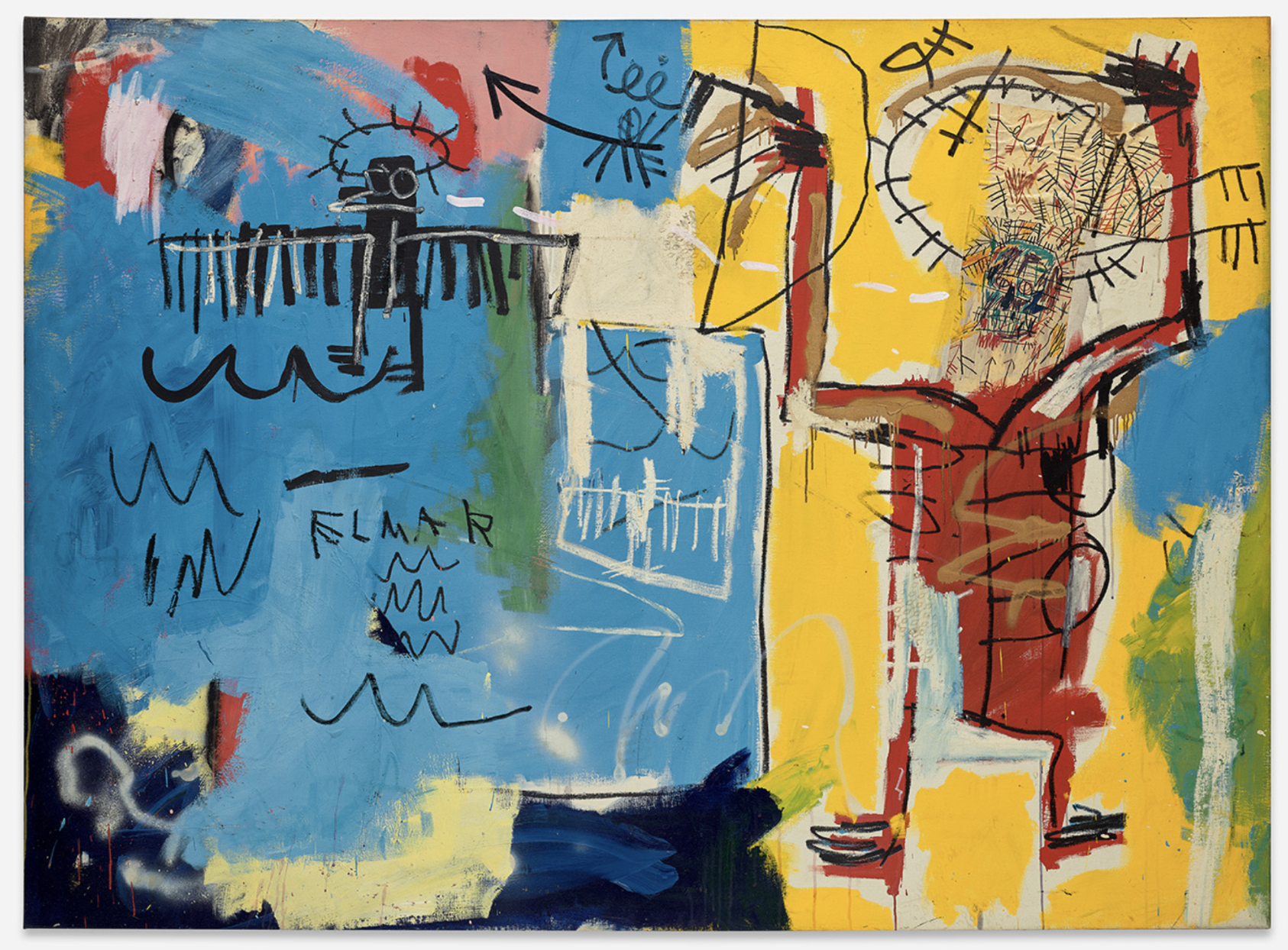
With Rene Magritte’s L'empire des lumières (1954) guaranteed to sell this week at Christie’s in the region of $95 million, it was a foregone conclusion that the high end of the November Evening Sales would be markedly different from May, when the the three big houses were led by the sale of Basquiat’s Untitled (ELMAR) at Phillips for a comparatively low $46.5 million.
The Magritte flew last night, fetching, with buyer’s premium $121.1 million, over $40 million above the artist’s previous auction record, set at Sotheby’s in 2022 for a painting of a similar subject. The price, among the highest realized at auction for a postwar painting, is still not remarkable in absolute terms; in the past decade we’ve become accustomed to nine-figure results for major works.
However, at a moment of correction in many market sectors, the strength of the Magritte sale suggests that the market for masterpieces may operate by its own logic and largely apart from trends seen elsewhere in the market.
If one were to wonder how the five $100+ million lots in the November 2022 Paul Allen auction would fare in today’s market, the Magritte sale may point to an answer. The Magritte’s realized price of $121.1 million is squarely within the range of the highest prices in Allen; more specifically, it would have been the third-highest sale in that auction, after Cezanne’s La Montagne Sainte-Victoire ($137.8 million) and slightly above Van Gogh’s Verger aves cyprès ($117.2 million). One might even extrapolate from the strength of demand for the Magritte that the paucity of highest-end consignments in recent auctions appears largely to be a supply-side matter.
Also selling this week for more than the above-mentioned $46.5 million Basquiat were Ed Ruscha’s Standard Station, Ten-Cent Western Being Torn in Half (1964) for a record-setting $68,250,000, offered by Christie’s sans guarantee with an estimate in the region of $50 million, and Claude Monet’s Nymphéas (1914-17) for $65.5 million at Sotheby’s.
Ed Ruscha, Standard Station, Ten-Cent Western Being Torn in Half, 1964, oil on canvas, 65 x 121½ inches
Ed Ruscha at Christie's
Ed Ruscha’s Standard Station, Ten-Cent Western Being Torn in Half (1964) will be offered this November at Christie’s, New York with an estimate on request in excess of $50 million.
The benchmark is his record-setting sale of Hurting the Word Radio #2 (also 1964) for $52.5 million at the same house in 2019.
This is the second $50M+ lot announced for the November auctions, the other being the Magritte, guaranteed to sell for at least $95 million.
This past May, the highest realized price was $46 million — very low by comparison with the records in most recent auction seasons.
With these two offerings, we can already expect the highest end of the fall auction season to look considerably different from the spring 2024 season.
It’s a buyer’s market for many artists, but the fluctuations at the highest end of the art market also depend highly on circumstance.
Hear more about trends in the art market on the recent episode of the Private Client Risk & Resilience Podcast, on which I was a guest this week.
Georges Seurat, Les Poseuses, Ensemble (Petite version), 1888, oil on canvas, 15.5 x 19.75 inches
Connecting Dots
It’s not news that the market has cooled for some artists, not least many of those emerging names who were unknown pre-pandemic and whose markets mushroomed on the synthetic fertilizer of cheap covid money. Emmanuel Taku’s prices tanked by March, so it’s a wonder why Zachary Small’s NYT article "A Sharp Downturn in the Art Market" (which follows Katya Kazakina’s market-contraction article from that month in using Taku as a key example) flashed on my phone as a timely notification on a Sunday morning. Let’s surmise that the cycle is slow for art-market journalists in August, at a moment between fairs and auctions.
Perhaps more puzzling, however, is Small’s propensity to connect dots. While he rightly cites high interest rates and inflation as factors affecting the markets for emerging artists such as Amani Lewis, Allison Zuckerman, and Taku, he situates that drop in contrast with a market “high point” of Christie’s auction of property from Microsoft co-founder Paul Allen in November 2022.
The Allen sale realized $1.5 billion, a record, by far, for any art auction. Five paintings fetched over $100 million that night, namely Georges Seurat’s Le Posses, Ensemble (Petite version) ($149.2 million); Paul Cezanne’s La Montagne Sainte-Victoire ($137.8 million); Vincent Van Gogh’s Verger aves cyprès ($117.2 million); Paul Gauguin’s Maternité II ($105.7 million); and Gustav Klimt’s Birch Forest ($104.6 million).
Small opines that the Allen sale “seemed to forecast a booming future for an industry that had been getting hotter by the year”, before he narrates the following phase of contraction, defined by speculative collectors unable to secure favorable financing for acquisitions. While he is quite right that much of the market, not just for the the likes of Taku, has been affected by the larger stringency, this macroeconomic condition may not be so decisive in the market for masterpieces.
The Allen sale was not a malfunctioning weather vane. It was a generational sale, with a concentration of rare and important pieces, unlike in overall caliber to anything we should expect to see offered in a single auction perhaps for decades, much less within the span of less than two years.
Multi-billionaire collectors who buy in the masterpiece market may have a purchasing capability that transcends factors such as interest rates and inflation that significantly affect other market segments. As such, one should ask whether the highest prices realized in the Allen sale for Seurat, Cezanne, et. al, in November 2022 would be substantially different if those same paintings were to be offered for sale today — or if in fact the paucity of results at the highest end is primarily a supply-side issue quite unrelated to the other matters at hand in the market today.
In any case, these are two different articles, crudely hammered together.
Hauser + Wirth booth at Art Basel Miami Beach, 2023, with paintings by Amy Sherald and Glenn Ligon
Selling the Purchaser
This spring I had the honor of being a guest on the “Private Client Risk & Resilience” podcast, hosted by Kurt Thoennessen, CAPI, Area Vice President, Private Client at Gallagher, and President of our New York Chapter committee of the Private Risk Management Association.
Kurt’s show broadly explores wealth protection and risk management strategies for high-net-worth individuals and families. He invites guests from a range of adjacent fields who address these topics in conversation with him. On this episode, I spoke with Kurt largely from the perspective of the art advisory side of my practice.
An excerpt from our conversation:
KT: “It’s almost as if the artist can choose who to sell to, if they’re at a certain level, and you as the art advisor are selling the purchaser. You’re making a sell to the artist — to sell your client.”
DS: “If a show has seven works of art and, and there are 30 interested parties, you have to explain why your client is somebody who should be among the seven and not the 23. Museums often get priority, because galleries are interested in boosting the profile of the artist, expanding their career, expanding visibility. That’s understandable, but the advisor can put forth an explanation as to why a certain collection is the place for the work to be. Being part of the right private collections is something that is beneficial for the artist. There are a lot of factors […] and collector profile is indeed one of them.”
If the collector (frequently with the help of an art advisor) is unable to secure such a purchase opportunity in the coveted primary market, one may have to resort to buying a similar work in the secondary market — at auction or otherwise. Whereas now, in a moment of market contraction, the gap between primary and secondary prices may be narrowing for some artists, that difference of prices, especially in a growth moment can be severalfold. To the extent to which high-value art is understandably recognized as an asset class, the advisor’s role in securing advantageous primary-market pricing can be key.
You can freely listen to the whole episode here.
High end of the non-art market
The highest auction sale this July — and one of the highest all year — was not of a work of art but rather a nearly complete fossil skeleton of a Stegosaurus, named “Apex.” The mounted dinosaur fossil fetched $44.6 million at Sotheby’s, New York on July 17, setting a record, by far, for a fossil sold at auction; the previous record was $31.8 million for the T-Rex skeleton, “Stan” at Christie’s, NY in 2020.
The buyer of “Apex” was financier Ken Griffin, who is well known for collecting at the top of the art market, e.g. his 2015 purchase of Willem de Kooning’s Interchange (1955) for a reported $300 million remains the highest known private sale nearly ten years later — and the second-highest known sale of a work of art in any market, after only the sale of the Salvator Mundi for $450 million at Christie’s, NY in 2017.
Griffin, however, has been showing himself to be cross-sector trophy collector, making other notable purchases at the highest echelons of the non-art market. The purchase price of “Apex” was slightly more than his purchase price of $43.2 million for a rare copy of the US Constitution at Sotheby’s, NY in 2021, edging out a crypto-invetor consortium of 17,0000 people, ConstitutionDAO.
Detail of constitution purchased by Ken Griffin at Sotheby’s
But how do such high prices for non-art items stack up with the art market?
The price paid for “Apex” is just under the price of $46.5 million for Basquiat’s Untitled (“ELMAR") at Phillips, NY, which led a season lacking in stratospheric art consignments. This was a mid-range Basquiat, selling for about half the $100M+ price that Griffin reportedly paid in 2020 for Basquiat’s Boy and Dog in a Johnnypump (1982), and less than a quarter of the $200M price that Griffin reportedly paid for Maezawa’s untitled Basquiat head this year, flipped from his $110.5 million purchase at Sotheby’s, NY in 2017.
Jean-Michel Basquiat, Untitled (ELMAR), 1982
As another point of comparison, Rothko’s Untitled (Yellow, Orange, Yellow, Light Orange) (1955) sold for $46.4 million at Christie’s, NY, in November 2023, slightly over half the artist’s record of $86.9 million set back in 2012 and about a quarter of the highest price reportedly paid for a Rothko, namely the private sale of No. 6 (Violet, Green and Red) for $186 million in 2014.
Realizing almost exactly the same price as “Apex” was Kandinsky’s record-setting Murnau with Church II (1910), which sold for $44.7 million at Sotheby’s London in March 2023. Diebenkorn’s auction record was set with the sale of Recollections of a Visit to Leningrad (1965) for $46.4 million at Christie’s, NY in November 2023, and Henri Rousseau’s auction record was set with the sale of Les Filaments (1910) at Christie’s, NY in May 2023.
Mark Rothko, Untitled (Yellow, Orange, Yellow, Light Orange), 1955
Wassily Kandinsky, Murnau with Church I, 1910
Richard Diebenkorn, Recollections of a Visit to Leningrad, 1965
Henri Rousseau, Les Flamants, 1910
Joan Mitchell, Sunflowers, 1990-91, oil on canvas in two parts, 110.25 x 157.5 inches, sold at Art Basel 2024 for $20 million
Joan Mitchell at Art Basel
Art Basel, in official recap messaging boasted about David Zwirner’s sale of Joan Mitchell’s Sunflowers (1990-91) (illustrated above) for $20 million as “close to the artist’s auction record of USD 29 million.” The sale was used to illustrate their point that “the upper echelons of the market remain firmly intact.”
Needless to say, 20 is not actually close to 29, but it’s also not an apples-to-apples comparison.
Mitchell’s auction record was set less than a year ago, in November 2023, with the sale of a ca. 1959 painting (illustrated below) for just over $29 million at Christie’s, New York against an estimate of $25 - 35 million. By contrast, the Mitchell painting sold by Zwirner at Basel in June 2024 is from 1990-91, over 30 years later.
A much more apt comparison to the Zwirner sale would be to the auction sale of another 1990-91 Mitchell Sunflowers diptych (illustrated below) for $27.9 million, also in November 2023, at Sotheby's New York; it carried an estimate at $20-30 million.
The Sotheby’s painting, which is the same size, is much more complex and therefore unquestionably superior to the Zwirner painting. But just how much better is it than the one that sold at Sotheby’s? Does the price difference of 40% accurately reflect the difference in quality?
$20 million is indeed a sizable sum in absolute terms, and consequently at one level, the sale might be seen as a confirmation of the function of the high end of the retail market. This price is also appreciably higher than any auction price realized for a Mitchell painting prior November 2023.
One is nonetheless left to consider how this painting compares with the Sotheby’s comparable, and whether the respective prices realized appear to be consistent with the relative strengths of the two paintings.
Joan Mitchell, Sunflowers, 1990-91, oil on canvas, 110.25 x 157.5 inches. Sold for $27.9 million at Sotheby’s, New York on Nov. 15, 2023
Joan Mitchell, Untitled, ca. 1959, 97.5 x 86.5 inches. Sold for $29,160,000 at Christie’s, New York on November 9, 2023
Matthew Wong, Shangri-La
Auction buy-ins (lots that fail to sell) are often used as convenient yardsticks for measuring market health (or lack thereof). While this metric has certain utility, buy-ins must be understood in their specific context.
For example, Matthew Wong’s “Shangri-La” failed to sell at Christie’s, Hong Kong in the May 2024 Evening Sale, when offered with an estimate of of HKD 42,000,000 - 62,000,000 ($5,376,798 - $7,937,178). This low estimate was higher than all but one hammer prices ever realized for Wong.
Perhaps even more notable was the fact that the low estimate was nearly $1 million (US) higher than the realized price (with buyer’s premium) of $4,470,000 for this painting at Christie’s, New York, just three and a half years earlier; that price was over six times its high estimate of $700,000.
Repeat sales in short succession typically carry more cautious estimates than this — even in robust markets. The wisdom of such a practice may be all the more apparent when a successive offering follows meteoric growth, as was the case for Wong.
“Shangri-La” is a visually distinctive, yet stylistically highly characteristic, and undoubtedly attractive painting. It was simply not fresh to the eyes of prospective collectors. Perhaps a more timid estimate would have been irresistible to some, and this might have ultimately proved to yield a sale.
My takeaway is that one might not extrapolate too much about larger trends from certain examples without analyzing the specificities of the sale.
Matthew Wong, Shangri-La, 2017, oil on canvas, 96 x 72 inches
Quote in Alex Greenberger's ARTnews article on Phillips's Evening Sale
I am pleased to be quoted in Alex Greenberger’s ARTnews article, “$46.5 M. Basquiat Leads Phillips’s Tepid $86.3 M. New York Auction”
Following the hour-long auction’s conclusion, some said it was tough to speak in grand pronouncements about the results. “We’re seeing a mixed, artist-specific market at Phillips tonight,” art adviser David Shapiro told ARTnews. But he said there were some positives: the sell-through rate was 92 percent, which he noted was solid, “notwithstanding some tepid results.”