
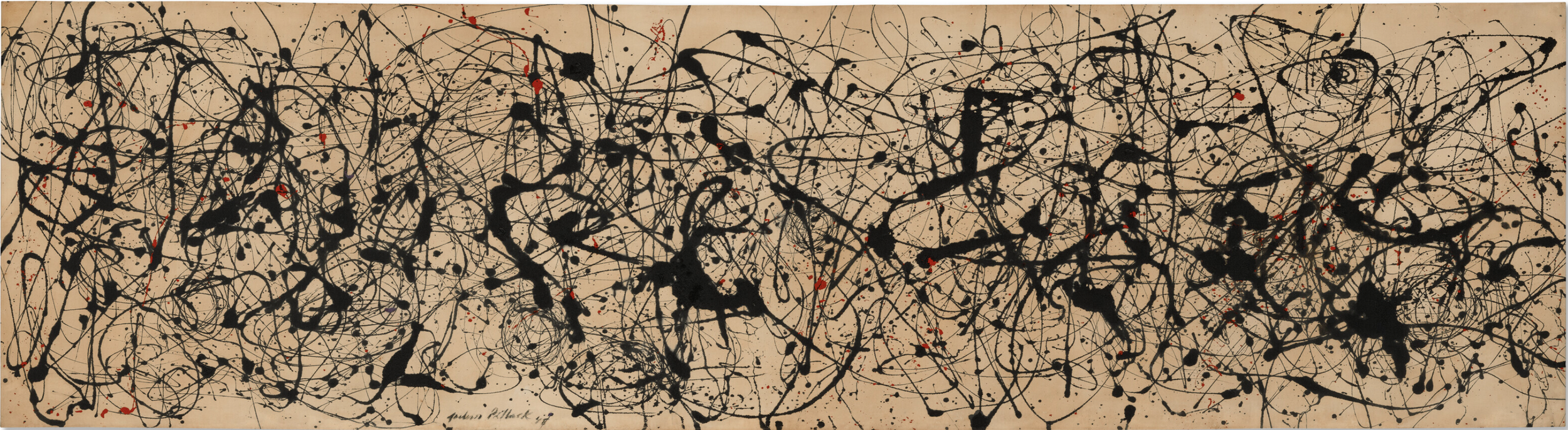
In the May 2026 auctions held over the past two weeks, 12 lots sold for over $40 million each (two more than in the Nov. 2025 sales) for a cumulative total of $851,022,500 (including buyer's premium). All of these $40M+ works were created in the twentieth century, and all were sold either at Christie's or Sotheby's with third-party guarantees (or "irrevocable bids" in Sotheby's terminology), so a strong high end was a foregone conclusion heading into the sales. Among this group, auction records were set for set for Jackson Pollock (who led the season), Constantin Brancusi, Mark Rothko, and Joan Miró.
In my calculations, 87.6% of the totals for $40M+ lots were from estate property, including the three highest lots, an even more pronounced pattern than what we saw in the November 2025 auctions (74%), further demonstrating that fluctuations in overall season-to-season results often depend more on circumstance-driven changes in supply at the high end than on changes in market confidence. However, to hedge against that comment a bit, there can be an element of discretion in when to sell estate property, as for Newhouse, in which works have been released to market periodically over time; clearly, they felt emboldened to sell key works now, and did so to remarkable results.
The top 12 in descending order of price realized:
1. Jackson Pollock, Number 7A (1948): $181,185,000 at Christie's (*auction record)
2. Constantin Brancusi, Danaïde (ca. 1913): $107,585,000 at Christie's (*auction record)
3. Mark Rothko, No. 15 (Two Greens and Red Stripe) (1964): $98,385,000 at Christie's (*auction record)
4. Mark Rothko, Brown and Blacks in Reds (1957): $85,780,000 at Sotheby's
5. Joan Miró, Portrait de Madame K. (1924): $53,535,000 at Christie's (*auction record)
6. Jean-Michel Basquiat, Museum Security (Broadway Meltdown) (1983): $52,717,500 at Sotheby's
7. Henri Matisse, La Chaise lorraine (ca. 1919): $48,405,000 at Sotheby's
8. Pablo Picasso, Tête de femme (Fernande) (1909): $48,480,000 at Christie's
9. Roy Lichtenstein, Anxious Girl (1964): $46,060,000 at Christie's
10. Cy Twombly, Untitled (1961): $45,485,000 at Christie's
11. Pablo Picasso, Arlequin (Buste) (1909): $42,640,000 at Sotheby's
12. Pablo Picasso, Homme à la guitare (1913): $40,885,000 at Christie's
"Icons" at Sotheby's: A private sales story
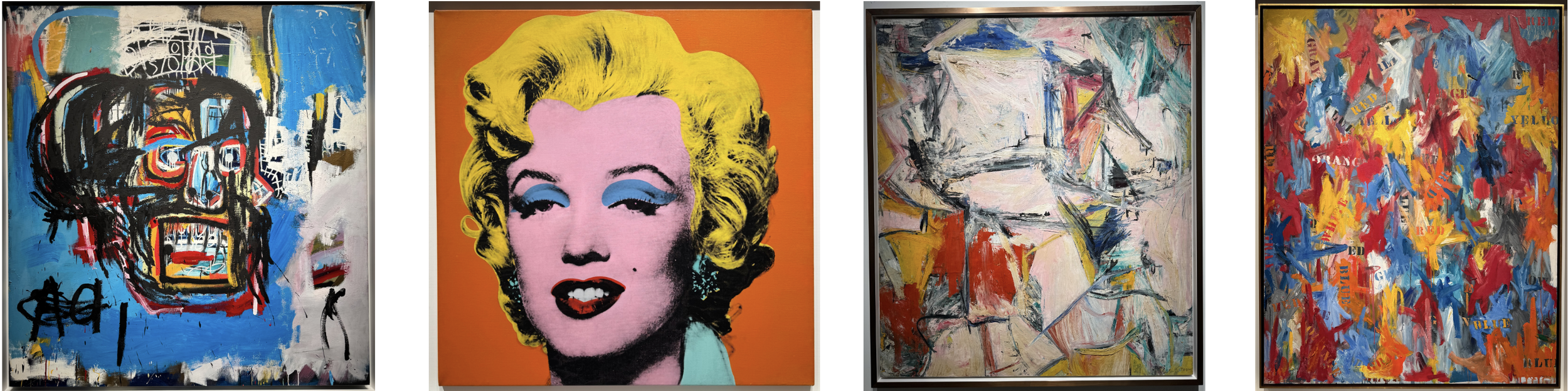
Sotheby's Icons exhibition, currently on view in New York, is intended as a mini compendium of key auction sales at the house over the decades. And yet, ironically, it is in large part a story about private sales -- and above all, those which brought four masterpieces to the collection of Citadel CEO and mega-collector Ken Griffin, notwithstanding silence in the exhibition wall text about the post-auction sales histories of these paintings.
The first is Basquiat's 1982 Untitled head, which sold to Yusaku Maezawa at Sotheby's in 2017 for $110.5 million, setting an all-time auction record for any American artist (surpassed at Christie’s in 2022 with the $195 million sale of Warhol’s 1964 Shot Sage Blue Marilyn). Maezawa’s $200 million private sale of this Basquiat to Griffin was reported in Artnet News in May 2024, but the story remained publicly uncorroborated until now.
The $200 million price attained for Shot Sage Blue Marilyn was in no small part benchmarked by another private Griffin purchase of a Warhol painting included in “Icons,” namely the closely related Shot Orange Marilyn (1964), originally purchased at Sotheby’s by S.I. Newhouse for $17.3 million in 1988 and much later, in 2017, sold to Griffin for approximately $200 million.
Also in Icons is De Kooning’s Interchange (1955), which sold at Sotheby’s for $20.7 million, but, market-wise, is perhaps best known for its 2015 private purchase by Griffin from music mogul David Geffen for a reported $300 million in a deal reported also to include the $200 million purchase of Pollock’s Number 17A (1948). The $300 million purchase of the De Kooning was the highest known price paid for a work of art in any market, and today, it is still second only to the Salvator Mundi by Leonardo da Vinci (and/or workshop), which fetched $450.3 million at Christie’s, NY in 2017.
The fourth significant Griffin loan to Icons is Jasper Johns’s False Start (1959), which sold for $17 million at Sotheby’s in 1988 and later, in 2006, was sold by Geffen to Griffin for a reported $80 million. It is worth considering what the painting might bring today, nearly 20 years later.
Irrespective of any possible such price growth, these four paintings comprise a total of approximately $780 million in total realized private sales, none of which is mentioned in the exhibition wall text. This is not a criticism; to the contrary, it was a pleasure and a rare opportunity to be able to see these major paintings, among others, assembled together for what may be the only time, but it’s also worth observing that the unspoken epicenter of this exhibition allegedly about auction sales, is indeed something quite apart than that.
Also not to miss in Icons are brilliant paintings by Kahlo, Klimt, Mondrian, Sargent, Still, and others, all looking their best in the Breuer building, itself a masterpiece.

AXA XL: Underwriting Case Study Series
This week I had the pleasure and honor to present a 2024 art market recap to underwriters at AXA XL Insurance.
Finishing 2024, statistics of decline could be seen everywhere, particularly when comparing overall year-to-year sales totals (i.e., 2024 with 2023 and especially 2022), and yet the overall picture is a more nuanced one. Broadly speaking, my presentation complicated the overarching correction narratives that have prevailed in the press.
Fluctuations in supply, particularly at the highest end, often depend on circumstantial factors such as the availability of major estates. As such, any comparison to 2022 will be skewed by the Paul Allen auction (especially) and the Ammann sale.
The failure of any lot to sell at auction for over $50 million in the first half of 2024 did look paltry given the offerings in the immediate past, but in the second half of the year, the three highest lots at auction totaled $255.4 million, over double the total of the three highest lots sold in the first half of the year.
The price realized for the Magritte alone ($121.6 million) was similar to the total of the prices realized for the three highest lots sold during the first half of the year, and the fact that it sold for over $25 million more than a confident estimate (with guarantee) suggests that present demand is strong in the market for highest-end masterpieces, when in fact there is supply.
As such, when Zachary Small asked in a doom-and-gloom article on November 2, 2023, whether the art market “will need to discount its masterpieces,” the answer seems to be a resounding, “NO” – at least not at the high end of the markets.
In 2024, collectors chased high-end non-art masterpieces as well, such as the stegosaurus skeleton, Dorothy’s ruby slippers, and Babe Ruth’s “called shot” jersey, which respectively shattered auction records for fossils, movie memorabilia, and sports memorabilia, collectively underscoring the expansive cross-sector outlook of the trophy market at present.
Other markets, however, were indeed cooler. The middle market remained artist-specific, with a continued trend toward selectivity for some artists. And in 2024, the market for many emerging artists fully collapsed, following a moment of rapid speculation-oriented growth in the covid period.
Also addressed in my 2024 market recap were notable developments such as:
The reuturn of the acceptance of cryptocurrency as payment for auction lots, by Sotheby’s for Cattelan’s Comedian.
The seismic security breach that took place in May when Christie’s website was hacked, making it inoperable during the marquee sale week.
Sotheby’s overhaul and subsequent reversal (less than a year later) of their fee structure, both for buyers and for sellers. The implications of this are also covered in my recent contribution for Artnews.

My 2025 Predictions in ARTnews
I am pleased to have my comments included in ARTnews today in the column "Art World Insiders Make Their New Year's Predictions for 2025":
David Shapiro, New York-based art appraiser and advisor: I see four trends from 2024 that may have an outsized impact on 2025. Firstly, the present strength in the equities market could cut both ways. Investors’ increased purchasing power could promote a turn away from the tentative market of 2023 and 2024, even with high interest rates. On the other hand, the strong performance of traditional investment vehicles could cause trepidation among some prospective buyers who had been more eager to collect art when equities markets were not performing well.
Secondly, the total of the three highest auction lots in the second half of 2024 was over double the total of three highest auction lots in the first half of 2024. Supply permitting, we should expect to see the continuation of this more expansive high end of the market. Christie’s record-shattering sale of René Magritte’s L’empire des lumières (1954) for $121.6 million, which was more than $25 million above an already confident estimate with a guarantee, suggests that we can expect to see competition and consequently strong prices in 2025 when truly significant works are offered for sale.
Thirdly, in 2024, extraordinary prices were paid for major non-art objects, shattering all-time records for fossils, movie memorabilia, and sports memorabilia. In 2025, we should continue to see a cross-sector approach to collecting at the highest levels.
And, lastly, Sotheby’s recent reversal of their dramatically overhauled fee structure, to be effected in February 2025 less than a year after implementation, will make the house more competitive again, particularly for day sale consignments. It should also, in turn, promote healthy competition on the part of the other major auction houses to secure consignments that they might have won more easily when Sotheby’s non-negotiable terms were so unfavorable to sellers in the latter part of 2024.

Auction estimate vs. appraisal
Perhaps I'm not the only one to have done a double take at Sotheby's loose language in their Instagram ad fed to me (and you?) today.
As Sotheby's should know perhaps as well as anyone, an auction estimate is not an appraisal. An auction estimate is a strategic figure designed to optimize results within a specific auction sale context.
An appraisal, by contrast, is an opinion of value (or, per USPAP, the act or process of developing such an opinion of value.). Depending on the type of value being appraised and the effective date of valuation used in an appraisal, and also depending on the specific auction sale context for a given estimate, an appraisal and an auction estimate for the same item may be similar -- or in many cases, they will differ significantly.
Sotheby's auction estimate for a work may be far higher than the estimate that a small auction house in the Midwest might give for the same work -- and both might be informed, accurate reflections of how best to market that item within their respective sale. These are not appraisals but rather context-bound marketing figures that reflect auction house perceptions of a specific market.

(l.) Banksy, Love is in the Bin, 2018 (formerly Girl with Balloon, 2006); (r.) Maurizio Cattelan, Comedian, 2018
Banksy and the Banana
When appraising art, the most relevant comparable sales are usually those by the same artist. If there are no appropriate comps, one may, by necessity, look to other artists. Find yourself appraising a Mantegna painting with no useful auction sales in 20+ years, you might look at the recent Botticelli sales to gain an understanding of present demand for significant Italian Renaissance paintings.
Doing such is relatively uncommon when appraising contemporary art, particularly by well-known artists whose works sell regularly at auction and privately. Yet, if I were appraising Maurizio Cattelan’s Comedian, the duct-taped banana that sold this week at Sotheby’s, New York for $6.2 million against an estimate of $1-1.5M, I would do just that.
Comedian is hardly alone within Cattelan’s oeuvre to trade in shock value, not even among works that have sold publicly. Known for his 18-karat gold toilet, America, created for the Guggenheim in 2016, Cattelan’s auction record was set the same year when, that May, one of three editions of Him (2001), a slightly under-life-size sculpture of Hitler sold for $17,189,000 for at Christie’s, NY. And yet, chilling as it may have been, this sculpture (an edition of which sold to Holocaust survivor Stefan Edlis) caused no great media spectacle, nor, perhaps more fundamentally, did it cogently pose any essential questions about the status of art itself.
It was not another Cattelan, but rather a Banksy that had me convinced that Comedian would perform far beyond its estimate, and enormously above its primary-market realized price of $120,000 at Perrotin’s booth at Art Basel Miami Beach in 2018. The appreciation rate of 50x seems about right given the sentiment that it tapped, as well as the attendant press, now coupled with deft marketing.
The best comparable is, in my view, the Banksy, formerly known as Girl with Balloon, which sold, considerably above estimate, for $1,364,669, at Sotheby’s London; upon hammering, the painting dropped and partially shredded. The owner kept the work, and the stunt became an instant media sensation. The shredded Banksy was offered again just three years later, again at Sotheby’s London, this time with a lofty estimate of £4,000,000 - £6,000,000 ($ 5,473,340 - $ 8,210,010), and it made multiples, fetching, with buyer’s premium £18,582,000 ($ 25,426,401), a new record for the artist.
Notoriety sells, without question. But why does a work become notorious? The commonalities extend beyond mere shock. Cattelan’s conceptual modified-readymade and Banksy’s shredded painting share tropes of self-destruction and decomposition, each updating concepts explored by artists for generations. Further, both fundamentally question the meaning and limits of what constitutes a work of art. For these reasons, I consider Love is in the Bin to be a pertinent comp for Comedian, arguably the most pertinent — and its repeat(-ish) sale in 2021 for 18 times higher than the 2018 sale is what caused me to believe that Comedian would soar as it did.

High end of the non-art market
The highest auction sale this July — and one of the highest all year — was not of a work of art but rather a nearly complete fossil skeleton of a Stegosaurus, named “Apex.” The mounted dinosaur fossil fetched $44.6 million at Sotheby’s, New York on July 17, setting a record, by far, for a fossil sold at auction; the previous record was $31.8 million for the T-Rex skeleton, “Stan” at Christie’s, NY in 2020.
The buyer of “Apex” was financier Ken Griffin, who is well known for collecting at the top of the art market, e.g. his 2015 purchase of Willem de Kooning’s Interchange (1955) for a reported $300 million remains the highest known private sale nearly ten years later — and the second-highest known sale of a work of art in any market, after only the sale of the Salvator Mundi for $450 million at Christie’s, NY in 2017.
Griffin, however, has been showing himself to be cross-sector trophy collector, making other notable purchases at the highest echelons of the non-art market. The purchase price of “Apex” was slightly more than his purchase price of $43.2 million for a rare copy of the US Constitution at Sotheby’s, NY in 2021, edging out a crypto-invetor consortium of 17,0000 people, ConstitutionDAO.

Detail of constitution purchased by Ken Griffin at Sotheby’s
But how do such high prices for non-art items stack up with the art market?
The price paid for “Apex” is just under the price of $46.5 million for Basquiat’s Untitled (“ELMAR") at Phillips, NY, which led a season lacking in stratospheric art consignments. This was a mid-range Basquiat, selling for about half the $100M+ price that Griffin reportedly paid in 2020 for Basquiat’s Boy and Dog in a Johnnypump (1982), and less than a quarter of the $200M price that Griffin reportedly paid for Maezawa’s untitled Basquiat head this year, flipped from his $110.5 million purchase at Sotheby’s, NY in 2017.
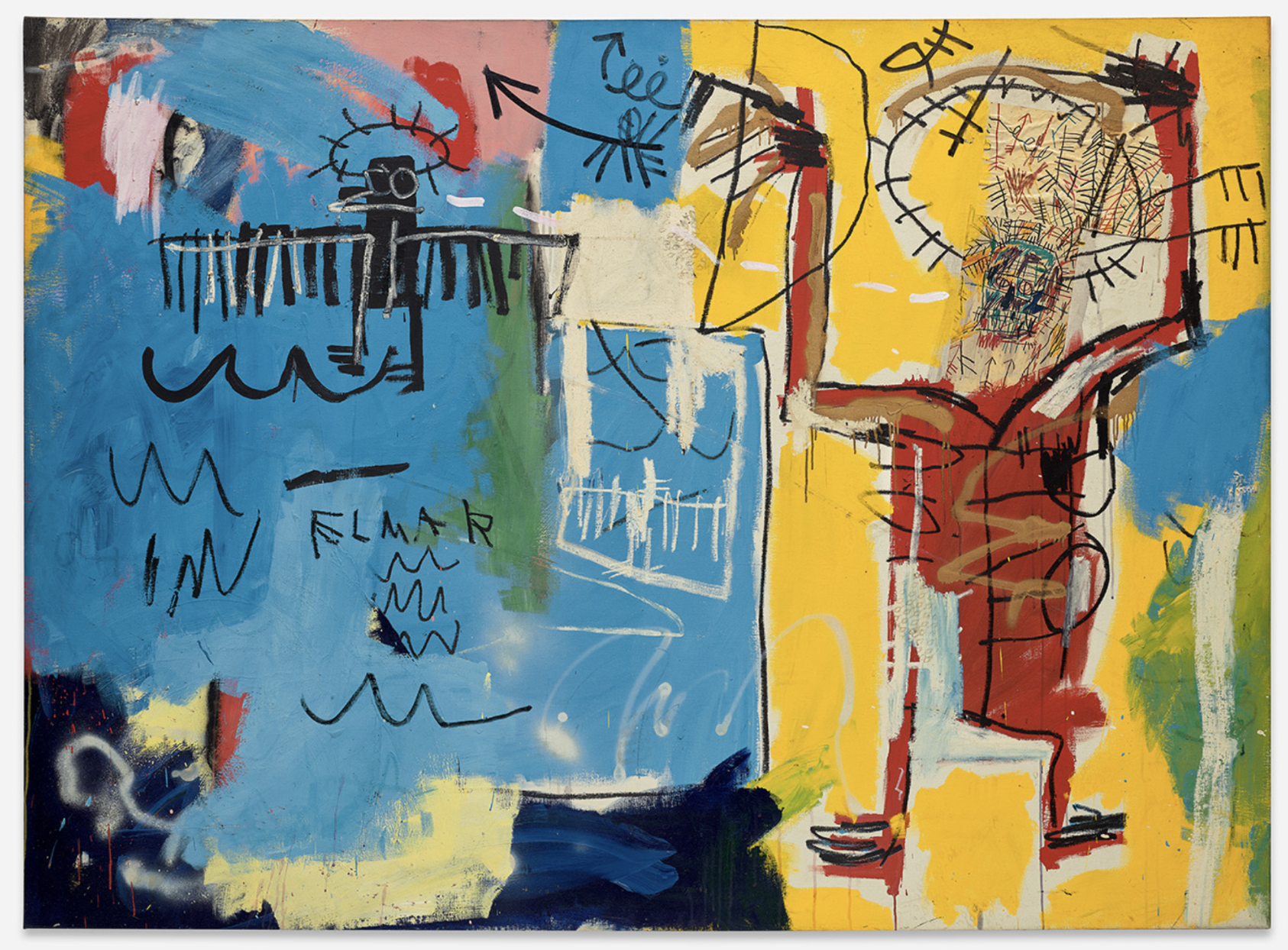
Jean-Michel Basquiat, Untitled (ELMAR), 1982
As another point of comparison, Rothko’s Untitled (Yellow, Orange, Yellow, Light Orange) (1955) sold for $46.4 million at Christie’s, NY, in November 2023, slightly over half the artist’s record of $86.9 million set back in 2012 and about a quarter of the highest price reportedly paid for a Rothko, namely the private sale of No. 6 (Violet, Green and Red) for $186 million in 2014.
Realizing almost exactly the same price as “Apex” was Kandinsky’s record-setting Murnau with Church II (1910), which sold for $44.7 million at Sotheby’s London in March 2023. Diebenkorn’s auction record was set with the sale of Recollections of a Visit to Leningrad (1965) for $46.4 million at Christie’s, NY in November 2023, and Henri Rousseau’s auction record was set with the sale of Les Filaments (1910) at Christie’s, NY in May 2023.

Mark Rothko, Untitled (Yellow, Orange, Yellow, Light Orange), 1955

Wassily Kandinsky, Murnau with Church I, 1910

Richard Diebenkorn, Recollections of a Visit to Leningrad, 1965

Henri Rousseau, Les Flamants, 1910
Basquiat, "Portrait of the Artist as a Young Derelict" at Sotheby's London
Basquiat’s Portrait of the Artist as a Young Derelict will be offered in Sotheby’s Evening Sale in London on Tuesday, June 25, estimated at £15-20 million (approx. $19 - 25 million), with a third-party guaruntee.
Although I usually appreciate ARTnews for its comparatively straightforward coverage of the art market (relative to other major publications), Daniel Cassady premised his article about this offering, “Basquiat Triptych to Sell at Sotheby’s London for Half Its Price from Two Years Ago”, on an inaccuracy.
Cassady notes that the painting was offered at Christie’s in 2022 with a $30 million estimate. However, he cites the present estimate as 15-20 million USD (NOT GBP, as it should be). Today’s GBP-to-USD currency conversion is 1.27, so his numbers were off by a lot. Sotheby’s low estimate is nearly two thirds, not half the previous estimate, and it certainly may sell above this guaranteed price.
Most works that are withdrawn or bought-in and then offered for public sale again just two years later would be unlikely to carry low estimates that are much higher than 2/3 of the previous unmet estimate. Not even Basquiat is immune from the strong drive among collectors to buy what's fresh to market — and to expect to pay much less for what is not.
Furthermore, a repeat sale which is guaranteed to fetch nearly two thirds of an overconfident estimate from just two years prior does not necessarily reflect what Cassady refers to as a “dip in prices.”
To express this point, Cassady cites the sale of Basquiat’s Untitled (ELMAR) at Phillips, New York last month for $46.5 million against an estimate (on request) of $60 million — but is this a dip? One must keep in mind that this price was far higher than any other auction price realized for a Basquiat containing Xerox collage.
Also this season, The Italian Version of Popeye has no Pork in his Diet (1982) sold for $32 million at Christie’s NY, slightly above its EOR of $30 million, and Sotheby's eclipsed the record for a Basquiat/ Warhol collaboration with the sale of an untitled 1984 painting for $19.3 million. And Kenny Schachter reported that Ken Griffin bought the Basquiat from Maezawa for $200 million this year, turning a profit of nearly $90M in just seven years.
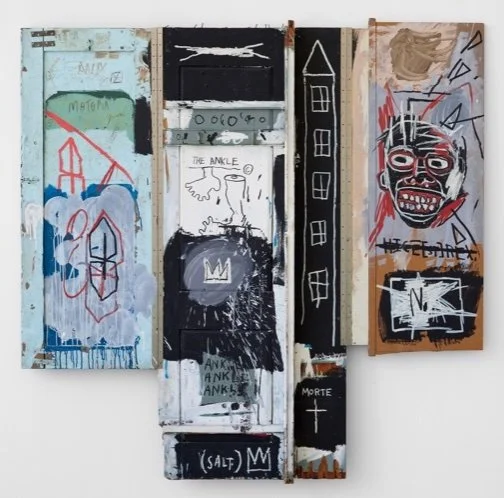
Jean-Michel Basquiat, Portrait of the Artist as a Young Derelict, 1982, oil, oil stick, and acrylic on wood and metal, 80 x 82 inches