
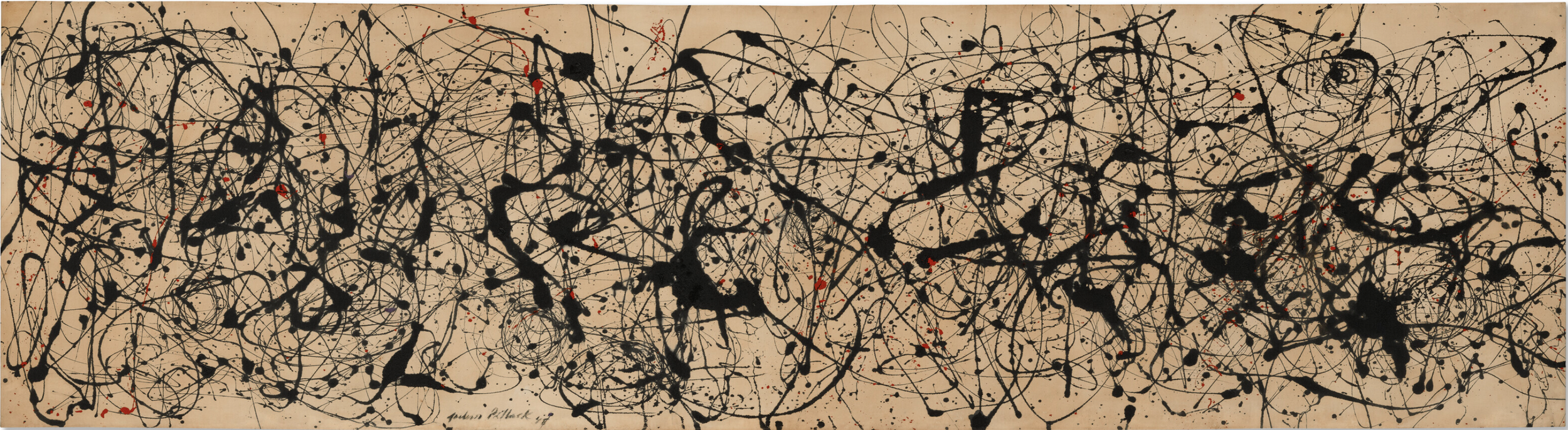
In the May 2026 auctions held over the past two weeks, 12 lots sold for over $40 million each (two more than in the Nov. 2025 sales) for a cumulative total of $851,022,500 (including buyer's premium). All of these $40M+ works were created in the twentieth century, and all were sold either at Christie's or Sotheby's with third-party guarantees (or "irrevocable bids" in Sotheby's terminology), so a strong high end was a foregone conclusion heading into the sales. Among this group, auction records were set for set for Jackson Pollock (who led the season), Constantin Brancusi, Mark Rothko, and Joan Miró.
In my calculations, 87.6% of the totals for $40M+ lots were from estate property, including the three highest lots, an even more pronounced pattern than what we saw in the November 2025 auctions (74%), further demonstrating that fluctuations in overall season-to-season results often depend more on circumstance-driven changes in supply at the high end than on changes in market confidence. However, to hedge against that comment a bit, there can be an element of discretion in when to sell estate property, as for Newhouse, in which works have been released to market periodically over time; clearly, they felt emboldened to sell key works now, and did so to remarkable results.
The top 12 in descending order of price realized:
1. Jackson Pollock, Number 7A (1948): $181,185,000 at Christie's (*auction record)
2. Constantin Brancusi, Danaïde (ca. 1913): $107,585,000 at Christie's (*auction record)
3. Mark Rothko, No. 15 (Two Greens and Red Stripe) (1964): $98,385,000 at Christie's (*auction record)
4. Mark Rothko, Brown and Blacks in Reds (1957): $85,780,000 at Sotheby's
5. Joan Miró, Portrait de Madame K. (1924): $53,535,000 at Christie's (*auction record)
6. Jean-Michel Basquiat, Museum Security (Broadway Meltdown) (1983): $52,717,500 at Sotheby's
7. Henri Matisse, La Chaise lorraine (ca. 1919): $48,405,000 at Sotheby's
8. Pablo Picasso, Tête de femme (Fernande) (1909): $48,480,000 at Christie's
9. Roy Lichtenstein, Anxious Girl (1964): $46,060,000 at Christie's
10. Cy Twombly, Untitled (1961): $45,485,000 at Christie's
11. Pablo Picasso, Arlequin (Buste) (1909): $42,640,000 at Sotheby's
12. Pablo Picasso, Homme à la guitare (1913): $40,885,000 at Christie's

Magritte and the Market for Masterpieces
In his January 2025 market recap in the Art Newspaper, Scott Reyburn called René Magritte’s L’empire des lumières, which sold for $121.6 million at Christie’s, the “one out-and-out masterpiece on offer in New York” in the November sales. Reyburn’s comment might be correct if his words were to be edited a bit: The Magritte was the one out-and-out masterpiece in the stratospheric market for highest-end trophies.
But the concept of a masterpiece should be understood as something that is exceptional within its own context. On the same date that the Magritte sold for $121.6 million, by far an all-time record for the artist, a record was also shattered at Christie’s for a Magritte work on paper (of the same title and subject as the painting); which fetched $18.8 million, over double its high estimate. This too could be considered a masterpiece within the context of his works on paper. On the same date, the second highest price for a Magritte work on paper was realized as well.
Sales such as these complicate the narrative of decline that many art market writers have used as a journalistic framework – and such press may even serve a self-fulfilling prophecy, scaring both prospective sellers and prospective buyers, as I have witnessed firsthand.
Without question there has been contraction in some markets in the past two years (e.g., as for many emerging artists), but in a truly recessionary period (or “slump” in Reyburn’s words), sales such as these simply would not be taking place.
One has to wonder, furthermore, what Reyburn has in mind when he says of the $121.6 million Magritte:
“[G]iven that this world-famous image was billed by the auction house as the greatest Surrealist painting to have ever appeared on the auction market, should it have made more?”
The Magritte sold for a price far higher than that of any Surrealist painting at auction or, to the best of my knowledge, any marketplace. It is hard to imagine how much more the painting could have realized on another date – and what that date might have been, given the obvious present taste for Surrealism, which could also be seen in the record-shattering top two sales of Leonora Carrington at Sotheby’s in 2024, including Les Distractions de Dagobert (1945), which made over $28 million in May.

AXA XL: Underwriting Case Study Series
This week I had the pleasure and honor to present a 2024 art market recap to underwriters at AXA XL Insurance.
Finishing 2024, statistics of decline could be seen everywhere, particularly when comparing overall year-to-year sales totals (i.e., 2024 with 2023 and especially 2022), and yet the overall picture is a more nuanced one. Broadly speaking, my presentation complicated the overarching correction narratives that have prevailed in the press.
Fluctuations in supply, particularly at the highest end, often depend on circumstantial factors such as the availability of major estates. As such, any comparison to 2022 will be skewed by the Paul Allen auction (especially) and the Ammann sale.
The failure of any lot to sell at auction for over $50 million in the first half of 2024 did look paltry given the offerings in the immediate past, but in the second half of the year, the three highest lots at auction totaled $255.4 million, over double the total of the three highest lots sold in the first half of the year.
The price realized for the Magritte alone ($121.6 million) was similar to the total of the prices realized for the three highest lots sold during the first half of the year, and the fact that it sold for over $25 million more than a confident estimate (with guarantee) suggests that present demand is strong in the market for highest-end masterpieces, when in fact there is supply.
As such, when Zachary Small asked in a doom-and-gloom article on November 2, 2023, whether the art market “will need to discount its masterpieces,” the answer seems to be a resounding, “NO” – at least not at the high end of the markets.
In 2024, collectors chased high-end non-art masterpieces as well, such as the stegosaurus skeleton, Dorothy’s ruby slippers, and Babe Ruth’s “called shot” jersey, which respectively shattered auction records for fossils, movie memorabilia, and sports memorabilia, collectively underscoring the expansive cross-sector outlook of the trophy market at present.
Other markets, however, were indeed cooler. The middle market remained artist-specific, with a continued trend toward selectivity for some artists. And in 2024, the market for many emerging artists fully collapsed, following a moment of rapid speculation-oriented growth in the covid period.
Also addressed in my 2024 market recap were notable developments such as:
The reuturn of the acceptance of cryptocurrency as payment for auction lots, by Sotheby’s for Cattelan’s Comedian.
The seismic security breach that took place in May when Christie’s website was hacked, making it inoperable during the marquee sale week.
Sotheby’s overhaul and subsequent reversal (less than a year later) of their fee structure, both for buyers and for sellers. The implications of this are also covered in my recent contribution for Artnews.

My 2025 Predictions in ARTnews
I am pleased to have my comments included in ARTnews today in the column "Art World Insiders Make Their New Year's Predictions for 2025":
David Shapiro, New York-based art appraiser and advisor: I see four trends from 2024 that may have an outsized impact on 2025. Firstly, the present strength in the equities market could cut both ways. Investors’ increased purchasing power could promote a turn away from the tentative market of 2023 and 2024, even with high interest rates. On the other hand, the strong performance of traditional investment vehicles could cause trepidation among some prospective buyers who had been more eager to collect art when equities markets were not performing well.
Secondly, the total of the three highest auction lots in the second half of 2024 was over double the total of three highest auction lots in the first half of 2024. Supply permitting, we should expect to see the continuation of this more expansive high end of the market. Christie’s record-shattering sale of René Magritte’s L’empire des lumières (1954) for $121.6 million, which was more than $25 million above an already confident estimate with a guarantee, suggests that we can expect to see competition and consequently strong prices in 2025 when truly significant works are offered for sale.
Thirdly, in 2024, extraordinary prices were paid for major non-art objects, shattering all-time records for fossils, movie memorabilia, and sports memorabilia. In 2025, we should continue to see a cross-sector approach to collecting at the highest levels.
And, lastly, Sotheby’s recent reversal of their dramatically overhauled fee structure, to be effected in February 2025 less than a year after implementation, will make the house more competitive again, particularly for day sale consignments. It should also, in turn, promote healthy competition on the part of the other major auction houses to secure consignments that they might have won more easily when Sotheby’s non-negotiable terms were so unfavorable to sellers in the latter part of 2024.

Ed Ruscha, Standard Station, Ten-Cent Western Being Torn in Half, 1964, oil on canvas, 65 x 121½ inches
Ed Ruscha at Christie's
Ed Ruscha’s Standard Station, Ten-Cent Western Being Torn in Half (1964) will be offered this November at Christie’s, New York with an estimate on request in excess of $50 million.
The benchmark is his record-setting sale of Hurting the Word Radio #2 (also 1964) for $52.5 million at the same house in 2019.
This is the second $50M+ lot announced for the November auctions, the other being the Magritte, guaranteed to sell for at least $95 million.
This past May, the highest realized price was $46 million — very low by comparison with the records in most recent auction seasons.
With these two offerings, we can already expect the highest end of the fall auction season to look considerably different from the spring 2024 season.
It’s a buyer’s market for many artists, but the fluctuations at the highest end of the art market also depend highly on circumstance.
Hear more about trends in the art market on the recent episode of the Private Client Risk & Resilience Podcast, on which I was a guest this week.

Jeff Koons, Balloon Monkey (Blue), 2006-2013
Koons at Christie's
Christie’s just announced that they will be offering Jeff Koons’s Balloon Monkey (Blue) (2006-13) in their 20th/21st Century London Evening Sale on October 9, 2024 — from the collection of Damien Hirst, no less.
The published estimate is £6,500,000 - £10,000,000, which is approximately $8,400,000 - $13,000,000, using the currency conversion provided by Eileen Kinsella in an Artnet News article on the consignment, titled “Damien Hirst Is Selling a $8.4 Million Jeff Koons at Christie’s During Frieze London.”
It has become something of a journalistic tic to refer to works of art by a value (e.g., $8.4 Million Jeff Koons) before any sale has taken place, and with no appraisal to cite. Such headlines tagging a work with a number often take their cues from an auction estimate, as was the case with this Koons. However, one must keep in mind that the pre-sale estimates given by auction houses are not appraisals; they are strategic figures assigned for specific sale purposes.
Kinsella reports that the Koons is guaranteed by Christie’s to sell. What she does not specify, however, is that the pre-sale estimates given by auction houses do not include buyer’s premium. It is possible that the sculpture is guaranteed for less than the low estimate, but if in fact it is guaranteed at the low estimate, even a sale to the guarantor would realize a higher price than $8,400,000; such a price would be the hammer price plus the buyer’s premium minus a pre-negotiated fee to the guarantor.

Georges Seurat, Les Poseuses, Ensemble (Petite version), 1888, oil on canvas, 15.5 x 19.75 inches
Connecting Dots
It’s not news that the market has cooled for some artists, not least many of those emerging names who were unknown pre-pandemic and whose markets mushroomed on the synthetic fertilizer of cheap covid money. Emmanuel Taku’s prices tanked by March, so it’s a wonder why Zachary Small’s NYT article "A Sharp Downturn in the Art Market" (which follows Katya Kazakina’s market-contraction article from that month in using Taku as a key example) flashed on my phone as a timely notification on a Sunday morning. Let’s surmise that the cycle is slow for art-market journalists in August, at a moment between fairs and auctions.
Perhaps more puzzling, however, is Small’s propensity to connect dots. While he rightly cites high interest rates and inflation as factors affecting the markets for emerging artists such as Amani Lewis, Allison Zuckerman, and Taku, he situates that drop in contrast with a market “high point” of Christie’s auction of property from Microsoft co-founder Paul Allen in November 2022.
The Allen sale realized $1.5 billion, a record, by far, for any art auction. Five paintings fetched over $100 million that night, namely Georges Seurat’s Le Posses, Ensemble (Petite version) ($149.2 million); Paul Cezanne’s La Montagne Sainte-Victoire ($137.8 million); Vincent Van Gogh’s Verger aves cyprès ($117.2 million); Paul Gauguin’s Maternité II ($105.7 million); and Gustav Klimt’s Birch Forest ($104.6 million).
Small opines that the Allen sale “seemed to forecast a booming future for an industry that had been getting hotter by the year”, before he narrates the following phase of contraction, defined by speculative collectors unable to secure favorable financing for acquisitions. While he is quite right that much of the market, not just for the the likes of Taku, has been affected by the larger stringency, this macroeconomic condition may not be so decisive in the market for masterpieces.
The Allen sale was not a malfunctioning weather vane. It was a generational sale, with a concentration of rare and important pieces, unlike in overall caliber to anything we should expect to see offered in a single auction perhaps for decades, much less within the span of less than two years.
Multi-billionaire collectors who buy in the masterpiece market may have a purchasing capability that transcends factors such as interest rates and inflation that significantly affect other market segments. As such, one should ask whether the highest prices realized in the Allen sale for Seurat, Cezanne, et. al, in November 2022 would be substantially different if those same paintings were to be offered for sale today — or if in fact the paucity of results at the highest end is primarily a supply-side issue quite unrelated to the other matters at hand in the market today.
In any case, these are two different articles, crudely hammered together.
Matthew Wong, Shangri-La
Auction buy-ins (lots that fail to sell) are often used as convenient yardsticks for measuring market health (or lack thereof). While this metric has certain utility, buy-ins must be understood in their specific context.
For example, Matthew Wong’s “Shangri-La” failed to sell at Christie’s, Hong Kong in the May 2024 Evening Sale, when offered with an estimate of of HKD 42,000,000 - 62,000,000 ($5,376,798 - $7,937,178). This low estimate was higher than all but one hammer prices ever realized for Wong.
Perhaps even more notable was the fact that the low estimate was nearly $1 million (US) higher than the realized price (with buyer’s premium) of $4,470,000 for this painting at Christie’s, New York, just three and a half years earlier; that price was over six times its high estimate of $700,000.
Repeat sales in short succession typically carry more cautious estimates than this — even in robust markets. The wisdom of such a practice may be all the more apparent when a successive offering follows meteoric growth, as was the case for Wong.
“Shangri-La” is a visually distinctive, yet stylistically highly characteristic, and undoubtedly attractive painting. It was simply not fresh to the eyes of prospective collectors. Perhaps a more timid estimate would have been irresistible to some, and this might have ultimately proved to yield a sale.
My takeaway is that one might not extrapolate too much about larger trends from certain examples without analyzing the specificities of the sale.

Matthew Wong, Shangri-La, 2017, oil on canvas, 96 x 72 inches
Quote in Karen Ho's ARTnews article about Christie's website
My comments are also included in Karen Ho's ARTnews article on Christie's hacked website:
https://www.artnews.com/art-news/market/christies-website-ongoing-outage-evening-auctions-online-bidding-1234706687/
