
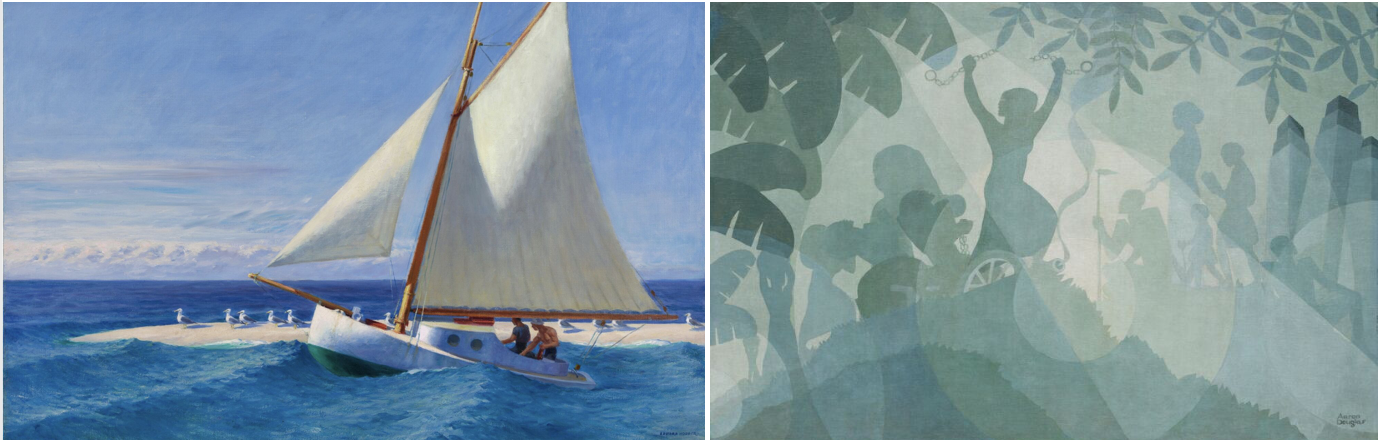
Two of the strongest performing lots in the Modern Evening Auction sale at Sotheby's were not from its main sector of Impressionist & Modern Art, but rather from the sector of American Art. Edward Hopper's maritime scene, "The Martha McKeen of Wellfleet" (left) fetched $47,830,000 (his 2nd highest auction result), appreciably above its high estimate of $30 million, and Aaron Douglas's Harlem Renaissance masterpiece, "Harriet Tubman" (right) sold for $14,480,000 (by multiples, the artist's auction record), vastly above its high estimate of $3,500,000. The marquee sale context was presumably a factor in propelling demand.
The sector of (traditional, i.e. not postwar and contemporary) American art has its own dedicated sale in January, which promises to be a much quieter affair. As has been typical for the past decade, key lots in sectors other than the Modern and Contemporary Art are sold in the marquee Evening Sales, where the lights are brightest. The most famous such example was the Salvator Mundi attributed in whole or part to Leonardo da Vinci, which fetched an all-time record price of $450M, not in an Old Master sale but rather in one dedicated to contemporary art. We can look at American art for other examples: Emanuel Leutze's "Washington Crossing the Delaware" (1851) made $45 million in a 20th Century Evening Sale at Christie's in 2022.
The market for (traditional) American remains largely soft. Works by many art historically significant American artists fetch much lower prices than they did 25 years ago -- and for some, it's been a steady decline. Other markets are relatively flat but certainly not growing. There may be many factors contributing to this decline, not least change of taste, but one factor furthering the contraction may be that when the masterpieces are sold during the separate marquee sale week, the dedicated sector-specific sales lack anchor works to bring excitement (and consequently, bidding) to the non-headline works in those sales.